
Tags
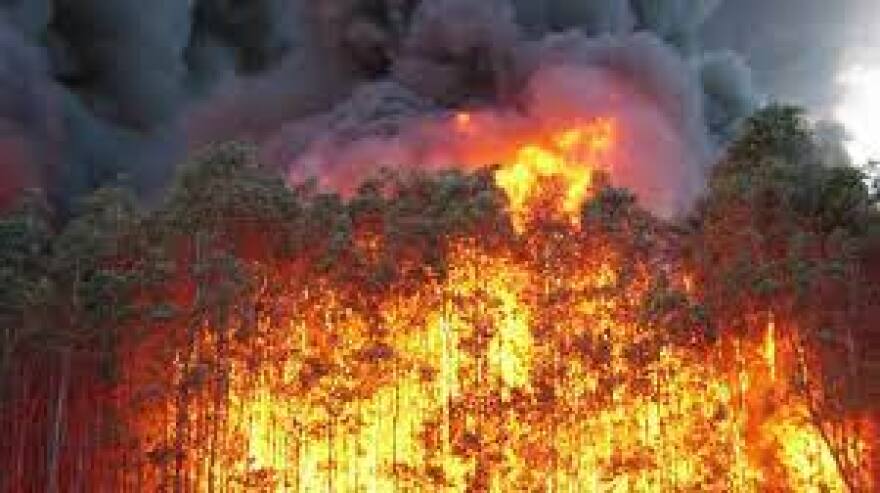
In this hyper connected world, it’s easy to forget that the connections go beyond the news, beyond mere knowledge of affairs far away. But this week found much of the United States’ eastern seaboard lying under a thick cloud of orange smoke that made it hard to breathe, hard to see, hard to make it through one’s day with ease. The fires are in northern Canada, but the smoke has spread, infiltrating peoples lungs and lives hundreds of miles away.
People in cities around the world experience air quality disturbances, sometimes constant. Seoul, Mumbai, Mexico City, Shanghai and more, plus much of the American west coast, know this all too well. The Americans affected by these fires know that the threat of the fire itself is far away, and eventually the smoke will dissipate. It will be just one more journal entry as we dance closer and closer to the inexorable flame that is climate change.
I often turn to the Torah for insights into today’s world. I found one in this week’s Torah portion when Moses lost patience with the Children of Israel and indeed, even with God. He cried out in despair,
“Why have You brought this evil on Your servant? Why have I failed to find favor in Your eyes, that You have placed the burden of this whole people on me? Did I conceive this whole people? Did I give birth to it, that You should say to me, ‘Carry it in your lap as a nurse carries a baby?’ … I cannot carry this whole people on my own. It is too heavy for me. If this is what You are doing to me, then, if I have found favor in Your eyes, kill me now, and let me not look upon this my evil.” Numbers. 11:11-15
At this, perhaps his lowest moment, Moses cried out from the depths of despair and sorrow. He saw no way out other than death itself.
God’s response? Not to comfort Moses, or even offer God’s own assistance. Instead, God told Moses to gather 70 elders, people who were already leaders in the community, and promised Moses, “I will come down… and I will draw upon the spirit that is on you and put it upon them; they shall share the burden of the people with you, and you shall not bear it alone.”
God was willing to help Moses, but only to the extent of teaching Moses how to train new leaders, a cadre of people he could rely on. The Torah is telling us that relying on God is not the answer, that burdens are meant to be shared among humans, and that no one person can be responsible for leading an entire community.
Even the most talented leader is not sufficient. She or he needs to share their own innate skills and knowledge with others. Their combined strengths can be merged and magnified, transcending those of individual humans.
The problems of climate change cannot be handled piece-meal. Borders are mere lines drawn on maps. Pollution, wildfires, intensifying storms and droughts, cannot be solved by individual nations. Only together, only by combining our best minds and committing sufficient resources from all nations, can we try to correct our course.
 SRQ Jew