
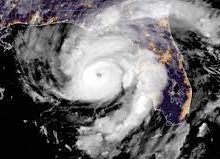
Thank you to all who reached out to check on me and my community as Hurricane Idelia bore down on Florida. It sideswiped my area and slammed into northern Florida, Georgia and the Carolinas. Those of us who were spared are sending prayers and money. The following was written two days before Hurricane Irma hit here in 2017.
You’d think praying would be pretty simple. But often it’s anything but. Sometimes it comes haltingly, or not at all. Even when we find the right setting, the right people to pray with, the right music and prayers, we can sit through an entire religious service and not feel a thing – no connection to the Divine, no inspiration, nothing.
And sometimes prayer comes easily. Sometimes we don’t need a book, a service, a rabbi or a minister. Sometimes the words pour out of our hearts, and our connection to the Source of All feels as natural and easy as breathing.
The Torah doesn’t teach us much about how to pray. We have examples – Isaac praying on Rebecca’s behalf, and Rebecca crying out to God about the twins struggling in her womb; Hannah’s silent prayer for a child; Moses asking God to heal his sister Miriam. But all of those are deeply personal prayers, said in moments of great need and spoken from the heart. We know how to say those kinds of prayers, because they are the ones we say without thinking.
Not until Deuteronomy does the Torah give us a set liturgy to recite, and it is a prayer of thanksgiving. Which in itself tells us something – when our hearts are breaking we find the words to pray without needing to be prompted, but when we are happy and satisfied, we might forget to give thanks, or not have the words to express our gratitude.
And oddly, this liturgy of thanksgiving is dictated to the Children of Israel while they are still in the desert, but is to be recited when they bring the first fruits of their harvest to the Temple. They won’t need this prayer for at least several years.
Why give it to them now? Why not wait until they will actually use it? I think the answer lies in the verse following the prayer, which says: “And you shall enjoy, together with the Levite and the stranger in your midst, all the bounty that the Lord your God has bestowed upon you and your household.” (Deut. 26:11)
The Torah’s message is that when we say a prayer of gratitude, it is the first step in a process of giving thanks. We then need to share our blessings with others in our community, and, remarkably, with the stranger in our midst. We are enjoined to reach out beyond ourselves, beyond our immediate families, to the people around us. Even strangers. May we be so blessed.
 SRQ Jew