
I can see clearly now, the rain is gone.
I can see all obstacles in my way.
Gone are the dark clouds that had me blind,
Gonna be a bright, bright, bright, sunshiny day.
Johnny Nash’s song from the early 1970s has been playing in an endless loop in my head, ever since I reread the story of Balaam and his ass in this week’s Torah portion (Numbers, chapter 22).
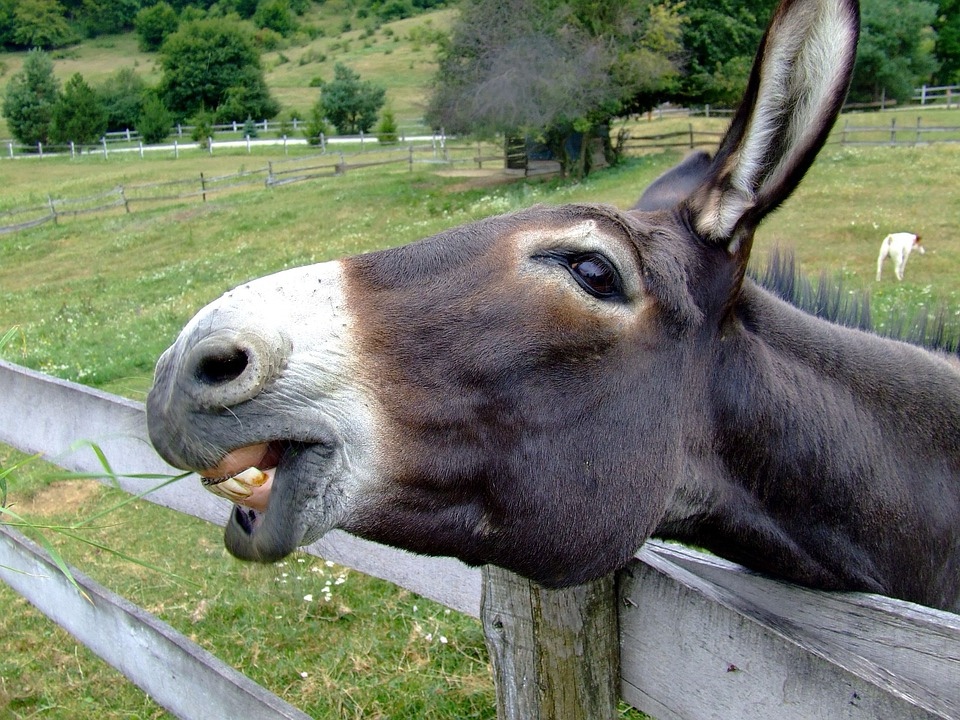
The only “person” who sees clearly in the story is Balaam’s faithful ass, who he has ridden for years. At the beginning, even God seems unsure of what Balaam should do.
The story begins with the king of Midian worrying about the possibility of war with the Israelite people who are moving through the desert. He decides to employ Balaam, a prophet-for-hire whose curses and blessings always stick. But instead of asking Balaam to bless his own army, he asks the prophet to curse the Israelites.
God tells Balaam not to go; then when asked again, says OK, you can go. But when he does go, God puts an Adversary (the Hebrew word is satan) in his way to thwart him.
Balaam’s ass sees the menacing angel in her path, and wisely moves off to the side. But Balaam sees nothing and beats her, so she continues, but again the angel is before her and she squashes Balaam’s foot against a fence, trying to get away. Again, he beats her. Finally, with nowhere to go, left or right, the ass lies down in the roadway. Once again, Balaam beats her.
And then, miraculously, the ass opens her mouth and speaks. She and Balaam engage in conversation, and surprisingly, Balaam does not seem to be at all surprised. His eyes are still blind to the apparition before them, and he doesn’t seem to notice the miracle of animal speech. Finally, it took an act of God for Balaam to see.
We use words for sight when we are reaching for words for understanding. “I see,” we say when we learn something new. Or, as politicians are wont to say, “I have a clear vision for the future of this country.” We talk about insight and foresight, and call intelligent people bright, brilliant, or even visionaries.
But vision can be blurred by emotion. Balaam was so angry at the ass that he couldn’t see what she, a dumb animal, saw clearly. When she spoke to him, he neglected to see the wonder in the moment, that his trusty steed was capable of communicating with him in language.
I live in Florida, where you can clearly a rain storm ahead. Driving down the road, you pass through the edge of the storm and are immediately plunged into a different world, a world of swirling darkness and thundering rain. Then, just as quickly, you emerge into full sunlight.
Our society seems to be wavering between understanding and blindness as well. On the one hand, politicians on both sides of the aisle are busy decrying antisemitism. On the other hand, this month a hate group that calls itself the GDL (Goyin Defense League) has been disrupting the city of Nashville with neo-Nazi rhetoric and behavior, and the news never makes it beyond the Jewish press.
Hatred blinds people to the value of the Other. Humans become dehumanized, and it becomes acceptable to treat them as animals. Or worse. Even Balaam, who relied on his donkey, didn’t take a moment to wonder about her behavior. He chose instead to beat her.
I find myself thinking about Johnny Nash’s song, and how fleeting understanding can be. Suddenly you are in the dark, and just as suddenly you can see clearly. As a society, we need to follow his lead, and clearly see the obstacles that are before us. Only then can we begin to heal our fractured nation.
 SRQ Jew