
Tags
I am often surprised when Jews say to me, “Jews don’t believe in angels.” What, then, are we to make of the many angels in Genesis? Don’t they realize that the song we sing every Friday night, Shalom Aleichem, is about welcoming angels into our home for Shabbat?
And what about our patriarch Jacob, who had not one but two profound encounters with angels? First, he lay down to sleep in the wilderness with only a rock for a pillow and dreamed of angels ascending and descending a ladder to heaven. Later, he was alone again when a “man”—understood to be an angel—wrestled with him until daybreak, wounding him and renaming him Israel, “God-wrestler.”
But Jacob had one more angelic encounter that is easy to overlook. It appears in just two brief verses, immediately before the Torah portion Vayishlach:
“And Jacob went on his way, and the angels of God met him. And when Jacob saw them, he said, ‘This is God’s camp’; and he called the name of that place Mahanaim” (Genesis 32:2–3). Mahanaim means “two camps.”
That’s it. No dialogue. No instruction. No dramatic moment. Just an encounter—and then, in the very next verse, Jacob decides to seek out his brother Esau, whom he has not seen in twenty years.
The place name becomes relevant: Jacob immediately divides his household into two camps, sending his wives, children, and concubines in different directions for protection—just in case Esau still harbors the anger of decades past.
Some people face conflict head-on. Others run from it. Jacob, despite his fear and uncertainty, chooses to move toward his brother, not away. And even then, he prepares for the worst.
Their reunion in the Torah is ambiguous. They embrace and kiss, but the text can be read to suggest that Esau may have bitten Jacob during that embrace. And once the dust settles, Jacob quickly separates himself and his family from Esau. They are brothers, but they remain two camps.
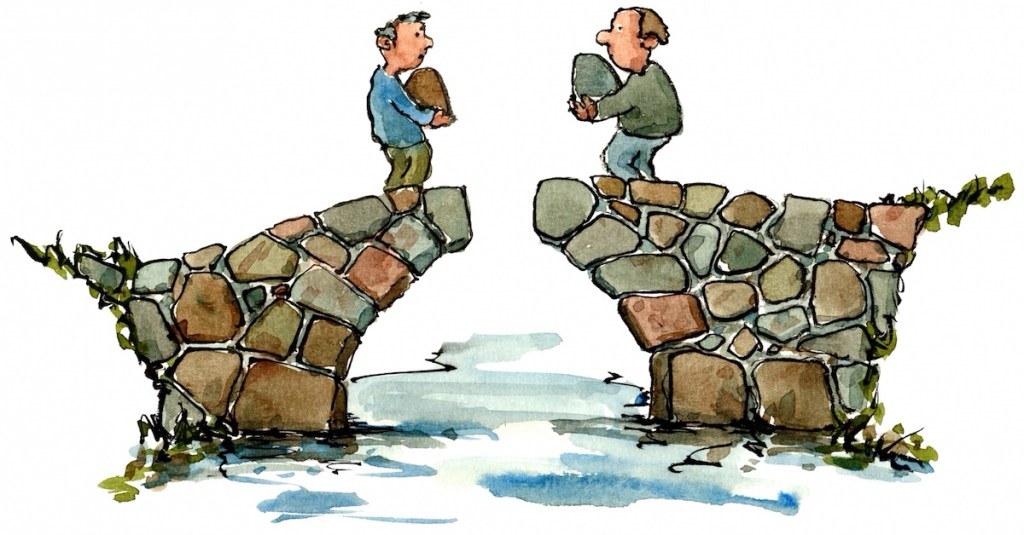
Two camps: angel and human. Brother and brother. They wrestle, reconcile, and part ways. Yet somehow they still meet in the middle long enough to be changed by one another. And in time, Jacob and Esau come together once more—this time to bury their father Isaac—just as Isaac and Ishmael reunited to bury Abraham.
Whenever someone comes to talk with me about strained family relationships, I inevitably say, “Families are complicated.” So are all relationships. In truth, we are all our own camps, carrying our own perspectives, histories, and hurts.
Despite that, when we are brave enough, wise enough, and willing enough to risk being wounded, we can sometimes meet in the middle. We can wrestle and reconcile. We can learn, grow, and even change—if we are willing to.
Postscript: I had no idea that I posted virtually the same essay last year. I thought I’d found it in my notes, unpublished. But an angel whispered in my ear and there it was. I apologize for the plagiarism, but at least I was plagiarizing myself!
 SRQ Jew